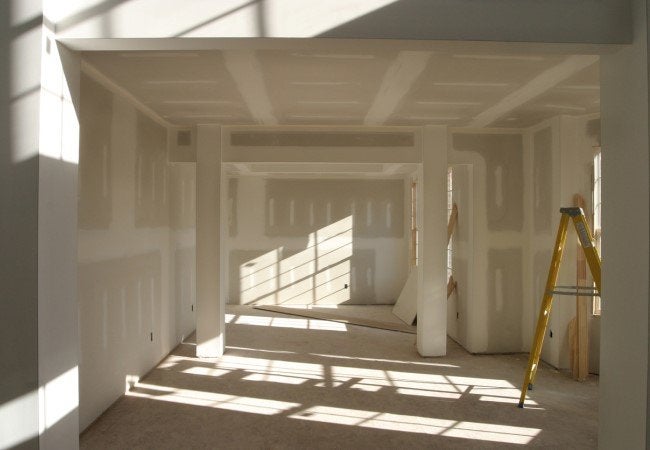
What can We Do?


Generally speaking, we can do everything related to gypsum wall board. If something needs to be done with your drywall, Legend is the right company for you. Just to give you an idea, here are our most popular services:

  • Patching and repairing

This is one of the simplest tasks when it comes to repair-work, but it still requires the expertise of a trained contractor if you want the best result. We’ll send people who’re trained for patching and repairing tasks. They can work with any texture.

  • Texture

Speaking of textures, we can help you achieve the texture that you want to decorate your gypsum wallboard.

  • Remodeling and restoration works

If you’re remodeling, someone needs to take make your walls look perfect and we’re the right company for it. A lot of our projects are from homeowners who’re remodeling so we’re experienced in this.

If your home was a recent victim to a fire, even if it’s just a small one, there’s a good chance that there’s smoke and fire damage. We’re the company to trust when it comes to the restoration of your sheetrock if this is the case.

  • Smooth finish

More and more homeowners are going for a level 4 or even level 5 smooth finish. Jump in on the trend with our help. We have the best finishers in the industry.

Legend of Taping Drywall


Eager to turn fresh drywall into flawlessly finished walls? Whether it’s your first taping job or you’re simply looking to improve your technique, level up your drywall taping skills with these tips and tools.

The Dos and Don'ts of Drywall Taping

Professional drywall taping crews make it look so easy: They move quickly, slather compound on every joint and nail hole, and leave behind walls that are ultra-smooth. While taping drywall isn’t a difficult task, a flawless finish can be hard to ace. That requires the right techniques, appropriate tools, and patience. With the following guidelines—and a little help from Hyde Tools—you’ll be taping walls like a pro in no time.

The Dos and Don'ts of Drywall Taping

Photo: hydetools.com

DO put your power drill to work.

Drywall mud must be smooth and free from lumps before you begin taping. Mixing powdered compound and water by hand is time-consuming, and you might not work out all the lumps of powder if you don’t stir long enough. Instead, use a mixing bit, such as Hyde Tools’ Stir Whip, attached to a heavy-duty ½-inch power drill to blend the compound until it reaches peanut butter consistency. Even premixed mud (always a good idea) can benefit from a burst of machine mixing, as it may have settled in the container.

DON’T buy the wrong mud for your project.

One of the most common mistakes new tapers make is selecting the wrong mud. Use an “all-purpose” or “setting” compound for the initial coat and for each additional coat—except the final coat. All-purpose compound goes on smooth and adheres well to joints and drywall tape. For the final coat, though, switch to a “topping” compound, which creates a fine surface and sands easily.

Unless you’re an experienced taper, steer clear of “fast-setting,” or “hot,” mud that dries very quickly. Hot mud can set up before you have a chance to smooth it out, leaving you with a lot of extra sanding.

The Dos and Don'ts of Drywall Taping

DO prefill wide joints.

Gaps 1/8 inch or wider between drywall panels can give a drywall installation an amateur appearance, but gaps aren’t the end of the world. Just fill ’em up before you get to work taping! Because the compound used to fill them has a tendency to shrink, it may cause the paper tape (and the entire initial coat) to warp if you fill the gaps at the same time as you apply your initial tape coating. If you prefill the gaps, however, and let them dry before you apply the tape coat, the compound in the gaps will not negatively affect the tape.

DON’T overlap drywall tape.

Applying a single layer of paper tape will help minimize any chance of ending up with a bulge in the finished wall. Begin by applying a thin layer of compound to a single vertical joint using a quality knife, such as Hyde Tools’ 6-Inch Flexible Black & Silver Stainless Steel Joint Knife. Its flexible blade will distribute mud uniformly over the joints. Then, immediately after applying mud to the entire length of a single vertical joint, position a strip of paper tape (about two inches shorter than the joint) over the wet mud. Pull the joint knife smoothly—working from the middle of the tape to each end—to bed the tape securely in the mud. Repeat with all vertical joints. When you tape horizontal joints, cut the tape so it fits between the vertical joints without overlap. If they do overlap, they will probably leave bumps.

DO take steps to reduce the mess caused by wet compound.

As you tape, you’ll find that splatters of drywall compound go just about everywhere: in your hair, on your clothing, and on everything else in the room. Wear a hat, protective eyewear (drywall compound stings!), and old clothing that you can toss when you’re done. Remove furniture from the room, and cover the floor with a canvas drop cloth.

DON’T skip nail or screw holes while applying each coat of compound.

It takes just a dab of compound to cover the head of a fastener. Smooth out the compound with your 6-inch joint knife. Only the dimple over the fastener should have any mud—the wall around it should be completely clear. Wipe the knife over the fastener a second time in a different direction to remove any excess mud.

DO cut away bubbles that form in the paper tape.

After the initial coat of compound dries, check for bubbles in the paper tape. These indicate that there wasn’t enough mud on the wall beneath the tape or that you may not have pressed the tape firmly enough with your joint knife. Fear not: You can remove these blips. Use a sharp utility knife, such as Hyde Tools’ Auto-Lock 18mm Utility Knife that features snap-off blades, to cut around the edge of the bubble, and then remove the loose piece of tape. Apply a dab of fresh mud over the bubble, smooth it out, and let it dry.

DON’T apply the next coat of mud over bits of dry compound.

While it’s important to smooth the compound with each coating, it’s common to end up with a few slight ridges caused by excess mud that escaped the corners of the knife and dried. These, in addition to any unintentional flecks of compound, should be removed before applying the next coat. Scrape them off using a taping knife, such as Hyde Tools’ 8-Inch Pro Hardwood Stainless Steel Extruded Backing Taping Knife. Rather than pulling the knife as you do when you spread the compound, simply push the edge of the blade along the wall to scrape off any hardened bits of compound.

The Dos and Don'ts of Drywall Taping

DO apply multiple thin coats instead of a thick coating of mud.

The biggest secret to a professional finish? Apply three or more coats of very thin compound rather than one or two heavier coats. Yes, it takes time for the compound to dry, but don’t try to rush the drywall taping process along by applying fewer, thicker coats. Doing so only increases your sanding time, and you may never be able to get the joints completely smooth. As well, compound shrinks slightly as it dries, so thick layers have a tendency to buckle and warp, leaving you with a hardened, lumpy mess.

DON’T forget to feather out joints.

“Feathering” involves applying a coat of mud and then using a taping knife to smooth the edges of the compound so thin that it’s hard to tell where the mud stops and the wall starts. It’s a technique that takes practice and quality tools. For most feathering situations, a good 10-inch taping knife, such as Hyde Tools’ 10-Inch Pro Project Blue Steel Extruded Backing Taping Knife, will give the best results. Hold the taping knife at a 45-degree angle and use light pressure—just enough to smooth out the edge, but not enough that you make a ridge in the mud.

DO add an extra swath of mud on each side of butt joints.

While standard drywall joints (where the long edges of two panels meet) have a factory bevel that accommodates a four-inch coating of compound, butt joints (where the ends of two panels meet) do not. There, the compound you apply tends to build up over the joint. To make these joints less noticeable, apply the first coat of mud and paper tape as usual, but apply two additional swaths—8 to 10 inches wide—on either side of the second coat of mud. This will give you a swath that spans 20 to 30 inches across the butt joint. By spreading the compound out over a wider distance, the joint will be less obvious. With each successive coat, continue to spread the mud in the same manner over the entire joint.

The Dos and Don'ts of Drywall Taping

Photo: hydetools.com

DON’T sand before protecting yourself and your home.

Your top coat has dried and you’re probably anxious to see just how smooth the finish turned out, but don’t start sanding until you have dust protection in place. Tape plastic sheeting over doorways, vents, and registers to keep drywall dust from filtering throughout the rest of the house. Wear old clothing, a hat, protective eyewear, and a full respirator mask. Drywall dust is incredibly invasive. It will cling to everything and even travel out of the room if you’re not careful.


 

Drywall Taping Tips

Drywall Taping Tips

How to get better taping results with less hassle

Tip 1: Mix the compound

Power mixing

Use a paddle-type mixer in a 1/2-in. drill for this mixing method.

If you’ve just opened a bucket, remove about a quart of the joint compound to make room for water. Then add about two or three cups of water and start mixing the compound. Pros use a powerful 1/2-in. drill with a special mixing paddle. But a hand-powered giant “potato masher”–type mixer made for this purpose works great for the casual taper.

The best consistency for joint compound depends on its purpose. It should be pudding consistency for hand taping, and a little thicker for the final coats. For smaller jobs, transfer some of the joint compound to another pail before mixing so you can make custom batches for taping or finishing.

Tip 2: Don’t use compound right out of the pail

Hand mixing

The potato masher-type mixer smoothes the compound and gets the air bubbles out.

Joint compound straight from the pail is simply too thick to apply and spread evenly. So before you start taping, begin by thinning and mixing the joint compound.

Tip 3: Prefill gaps with “setting” compound

Filling gaps

Fill gaps top to bottom with setting compound.

Setting-type compound is perfect for prefilling because it hardens quickly and doesn’t shrink as much as regular joint compound.

Start by breaking or cutting out areas of the drywall that are broken or crushed, then peel away any paper shreds left around the edges. Then mix up a small batch of setting-type compound (if you mix too much, it’ll harden before you use it up). Mix it thick so it’ll stick in the holes without sagging. When the compound sets to the hardness of soap, scrape off high spots and lumps with the edge of your taping knife. Also fill gaps between sheets with setting compound and let it harden before you apply joint compound and tape.

Tip 4: Cut “V” grooves at butt joints

Cutting a “V” groove

Hold a utility knife at an angle and slice off the drywall edges to create the groove.

The paper facing on drywall ends may show through the taped seam. Avoid this problem by carving a shallow “V” groove between the sheets after you hang them. Then fill the “V” with setting-type joint compound before you cover the seam with joint compound and tape. This will really help out with the toughest taping challenge—butt joints.

Tip 5: Scrape ridges and bumps between coats

Scraping a ridge

Run a 6-in. taping knife over all the joints when dry to knock off ridges. The ridges are usually there, even if you don’t see them!

Even experienced tapers leave little globs of joint compound and an occasional ridge. If you don’t get rid of these after they dry, they’ll cause you all kinds of grief. Chunks of dried compound can break off and get stuck under your taping knife and cause streaks in your fresh joint compound that you’ll have to fill in later. Avoid the problem by scraping the joints between coats. All it takes is a quick once-over with a 6-in. taping knife to knock off ridges and bumps. Hold the knife at a low angle and push it across the taped joints.

Tip 6: Embed the tape completely

Embedding the paper tape

Press the tape into the compound, spreading the squeeze-out along the sides.

You can avoid a lot of extra work later by making sure paper tape is thoroughly embedded in the joint compound. Start by laying a thick bed of joint compound down the center of the seam. Then smooth it down to a consistent thickness of about 1/8 in. with your 5- or 6-in. taping knife. Wet the tape and press it into the joint compound. Then, starting at the center and working toward the ends, press the tape into the joint compound with your knife. The key to success is making sure joint compound oozes out from under both sides of the tape as you embed it.

Tip 7: Don’t leave dry tape

A sign of dry tape

If compound doesn’t ooze out, the tape probably won’t stick in that area.

Paper tape that’s not completely embedded in joint compound will bubble or fall off later when it dries. Keep a close eye on the tape as you embed it with the taping knife. If you see sections of the tape where one or both sides remain dry with no joint compound oozing out, pull off the tape and apply more joint compound under the dry areas. Then reapply the tape over the new joint compound.

Tip 8: Don’t mud both sides of the corner at once

Smoothing both sides

Working both sides of a corner at once seems faster, but actually results in more nicks, dents and ridges.

It’s pretty easy to get a nearly flawless coat of joint compound on the first side of an inside corner. But if you start on the second side before the first is dry, things get tough. That’s because it’s impossible to avoid messing up the wet compound on the first side, and you won’t be able to avoid making a groove in the corner.

Tip 9: Mud one side of the corner at a time

Mudding one side

Smooth one side; then allow it to dry before mudding the other side.

The trick is to coat one side of each corner and let it dry overnight before troweling joint compound on each adjacent side. Start by spreading about a 3-in. band of joint compound over the tape on one side of the corner. Then smooth it with a 5- or 6-in. taping knife. Press the outside edge of the knife against the drywall to create a feathered edge that won’t require much sanding. Try to avoid leaving too much joint compound over the tape—a buildup at the corner will make it harder to fit baseboard or crown moldings tight to the wall.

Tip 10: Tape over metal corner beads

Taping a metal corner

Taping the metal corner helps to prevent cracks.

Cracking along the edge of metal outside corner beads is a common problem. And usually it doesn’t happen until after the wall is painted, so repairing the crack means repainting the wall again! There are a couple of solutions. One method that’s become standard practice for professional tapers is to use special corner bead that is held on by joint compound rather than nails. No-Coat Ultratrim is one such product.

If you don’t want to go shopping for special corner bead, avoid future cracking by applying paper tape over the metal edge after you’ve nailed on the bead. Embed the tape just as you would on any joint. Then fill the corner as usual.

Tip 11: Wet the paper tape

Wetting tape

Dampen, but don’t soak, the tape in a bucket of water.

Wetting the tape before you embed it in the joint compound can help eliminate troublesome bubbles that show up after the joint dries. Keep a bucket of water nearby and quickly run each piece of tape through it before applying the tape to the wall.

Tip 12: Cut out bubbled or loose tape

Cut around bubbled area

Completely remove all bubbled tape and remud.

Even if you’re diligent about embedding the tape, you’ll occasionally run into a section of tape that bubbles or comes loose. Don’t try to bury the problem with more compound. It’ll just reappear later. Instead, cut around the damaged area with a utility knife and remove the tape. Avoid a divot in this spot by filling the recess with setting compound and letting it harden before applying another coat of joint compound.